- English
- French
- German
- Portuguese
- Spanish
- Russian
- Japanese
- Korean
- Arabic
- Greek
- German
- Turkish
- Italian
- Danish
- Romanian
- Indonesian
- Czech
- Afrikaans
- Swedish
- Polish
- Basque
- Catalan
- Esperanto
- Hindi
- Lao
- Albanian
- Amharic
- Armenian
- Azerbaijani
- Belarusian
- Bengali
- Bosnian
- Bulgarian
- Cebuano
- Chichewa
- Corsican
- Croatian
- Dutch
- Estonian
- Filipino
- Finnish
- Frisian
- Galician
- Georgian
- Gujarati
- Haitian
- Hausa
- Hawaiian
- Hebrew
- Hmong
- Hungarian
- Icelandic
- Igbo
- Javanese
- Kannada
- Kazakh
- Khmer
- Kurdish
- Kyrgyz
- Latin
- Latvian
- Lithuanian
- Luxembou..
- Macedonian
- Malagasy
- Malay
- Malayalam
- Maltese
- Maori
- Marathi
- Mongolian
- Burmese
- Nepali
- Norwegian
- Pashto
- Persian
- Punjabi
- Serbian
- Sesotho
- Sinhala
- Slovak
- Slovenian
- Somali
- Samoan
- Scots Gaelic
- Shona
- Sindhi
- Sundanese
- Swahili
- Tajik
- Tamil
- Telugu
- Thai
- Ukrainian
- Urdu
- Uzbek
- Vietnamese
- Welsh
- Xhosa
- Yiddish
- Yoruba
- Zulu
Complete Guide to Fire Robot Throwing Foam Technology
Fire Robot Throwing Foam is a huge change in how firefighters and workplace safety teams put out high-risk fires. This technology lets remote-controlled fire reduction happen in places where people would be dangerous or unable to go because it combines robotic ground vehicles with advanced foam projection capabilities. These systems send specialized foam concentrates over lengths of more than 60 meters, covering unstable materials with a shield of protection and stopping thermal runaway situations. These robotic platforms are made for petrochemical plants, EV battery fires, underground tunnels, and small industrial areas. They fill in important safety gaps while improving fire control efficiency.
Understanding Fire Robot Throwing Foam Technology
Core Components and System Architecture
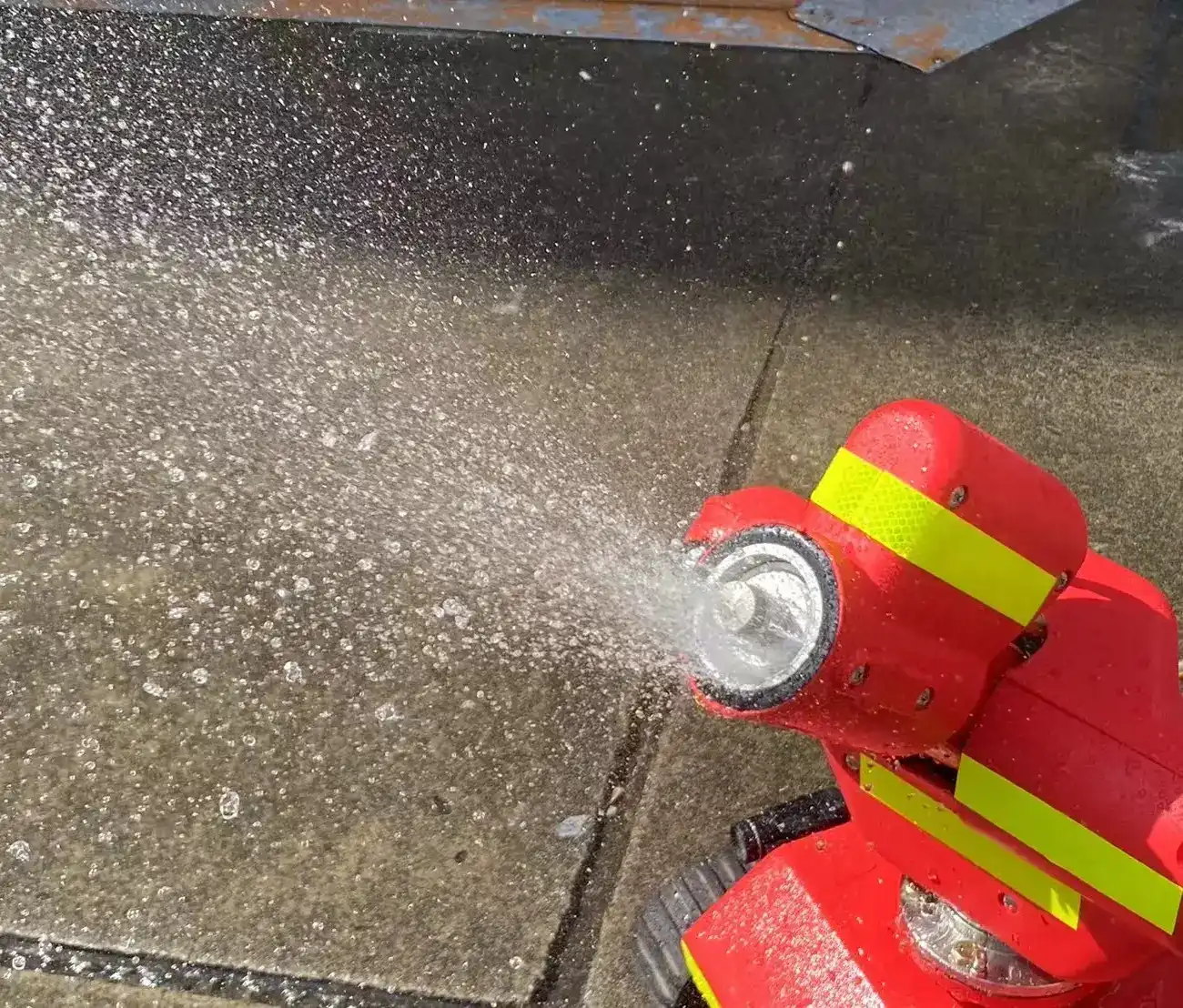
Three important parts make up modern robotic foam control platforms. All-terrain, flame-resistant rubber crawlers on the mobile base can usually handle slopes up to 40 degrees and objects up to 100 mm high. Battery-powered servo motors allow for exact movement and the ability to turn in place, which makes it possible to move through tight spaces and crowded areas. The control design relies on remote operation from more than 200 meters away. Mesh networking protocols keep the connections going even when buildings or thick smoke block the straight line of sight.
Foam Generation and Delivery Mechanisms
The foam delivery system works at pressures of about 0.8 MPa, making mist particles as small as 60 micrometers so that heat can be absorbed and vapor can be stopped. Flow rates are usually between 0.3 and 0.4 liters per second, and each nozzle piece can cover up to 4 cubic meters. No matter what the concentrate's density is, positive pressure proportioners make sure that the foam quality stays the same. DN65 inlet plugs make it easy to connect a hose quickly to standard fire department equipment, and DN40 exit ports let you add modular devices like special EV cooling lances.
Foam Concentrate Selection
In the past, Aqueous Film-Forming Foam was the most popular choice for Class B fires because it quickly put out flames and sealed off fuel. When you use expansion rates between 1:6 and 1:20, you get static blankets that don't burn back when hydrocarbons spill. But environmental laws are pushing for foam replacements that don't contain fluorine and get rid of lingering organic pollutants while keeping the suppression performance. These later concentrates use manufactured surfactants and polymers, and when mixed right, they have similar swelling and drainage properties.
Safety and Autonomy Features
The IP65 waterproof grade keeps computer parts safe from sprays and other harsh conditions. Self-cooling systems keep things from getting too hot during long processes, so they can keep working for up to 16 hours straight without any help from outside sources. Long-wave infrared cameras can see through thick smoke to find thermal hotspots, and built-in sensors can find dangerous gas amounts and structure instability. When system parameters go over safe limits, emergency shutdown procedures are set off immediately, and fail-safe mechanisms make sure that the system is turned off safely if communication is lost.
Advantages of Using Fire Robot Throwing Foam Over Traditional Methods
Enhanced Personnel Safety
When firemen are taken out of direct danger zones, they are no longer exposed to thermal radiation, poisonous combustion products, or the risk of buildings collapsing. Robotic platforms can work in harsh environments and temperatures that would render humans useless in seconds if they weren't secured. This ability to stand off is especially useful during accidents at chemical plants where many dangers exist at the same time, or in underground parking garages where a lot of smoke and few ways to get out create deadly conditions. Through onboard cams, remote workers stay aware of what's going on while leading suppression efforts from safe places.
Improved Response Speed and Precision
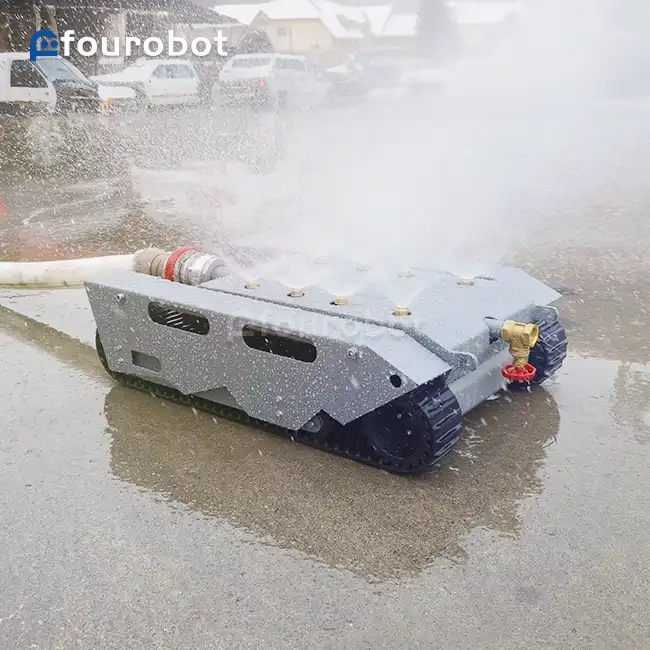
Because they are small, they can be quickly deployed from regular fire trucks. A standard compact EV fire robot is only 780 mm long, 480 mm wide, and 210 mm high, and it weighs about 50 kilograms all together. With these specs, two-person teams can set up tools within minutes of it arriving. With travel speeds of up to 4 km/h and exact maneuverability, the unit can get to target areas faster than a person could release a hose by hand on industrial sites that are already crowded. Using remote controls, nozzles change the spray patterns and angles of projection in real time, making the best use of foam based on observations of how fires behave.
Here are the operational efficiency gains these systems deliver:
- Immediate Deployment: Unlike regular foam trucks that need to be positioned and set up, portable robots can start working two minutes after dumping, which cuts down on important early-stage fire growth windows.
- Sustained Operations: Working nonstop for up to 16 hours supports long-lasting events like lithium-ion battery thermal runaway, where re-ignition may happen hours after the initial knockdown due to exothermic reactions within damaged cells.
- Reduced Water Demand: Fine mist technology improves surface area contact, providing better cooling with 70% less agent volume compared to straight stream application. This reduces water damage and runoff's negative effects on the environment.
These skills directly lead to faster incident times and less damage to property. When there are fires in a refinery's tank farm, the Fire Robot Throwing Foam application sets up protective walls faster than human teams can safely move, stopping the fire from spreading to nearby storage vessels.
Financial and Operational Benefits
When you think about the special training and tools needed for hand foam operations, the drop in labor costs becomes clear. Robotic systems have training for operators that lasts only a few days instead of months, and during large-scale events, one remote operator can control multiple units at the same time. Maintenance costs are low because the machines are simpler and have fewer parts that wear out than traditional fire trucks. The units' small storage footprint makes the best use of fire truck cabinet room so departments can take more emergency gear without needing bigger vehicles.
Comparing Fire Robot Throwing Foam With Alternative Firefighting Solutions
Performance Against Fixed Sprinkler Systems
Fixed foam-water spray systems work automatically and cover a large area, but they aren't as flexible as robotic platforms. Sprinkler coverage is based on plans that were set up at the time of installation. This means that there are gaps when fires start in areas that aren't covered or when storage arrangements change. Fire robot throwing foam units move around on the fly, focusing agent application where real-time conditions require it. This adaptability is very useful in places like warehouses, factories, and loading docks where the structure of operations changes all the time.
Manual Firefighting Method Limitations
Teams must stay within safe working lengths of hand-held foam cannons, which are usually 20 to 30 meters for good stream reach. People who are close to this area are exposed to direct heat loads that are higher than what is safe for fully grown fires. Monitoring the atmosphere shows that at these distances, harmful gas levels often reach levels that are quickly dangerous to life and health during chemical and oil spills. These risks of exposure are taken away by robotic deployment, which also keeps projection distances high and application times long enough for crews to get tired.
Specialized EV Battery Fire Challenges
Lithium-ion battery fires are hard to put out in a special way. When thermal runaway happens, temperatures inside reach over 800 degrees Celsius, and normal water streams often bounce off of battery covers without going deep enough. This is fixed by the Portable EV Fire Robot's removable Otter-X cooling module, which sends either water mist or potassium oxide as a fire extinguisher straight to battery packs that aren't working right. Gas particles as small as 2 to 4 micrometers get into the spaces between cells and stop exothermic chain processes. Coverage areas of 2 to 4 cubic meters per section make sure that the battery pack is completely submerged, and the self-cooling system keeps the robot chassis from getting damaged during long activities close together.
The platform's low footprint and 4 cm of chassis clearance make it possible to work under cars, placing suppression equipment at the best angles for getting to batteries under the chassis. This setup is necessary when heat runaway starts in lower battery cells that aren't reachable by normal master streams.
Procurement Guide: How to Choose and Buy Fire Robot Throwing Foam Systems
Application Requirement Assessment
First, procurement teams should make a list of all the different fire situations that their buildings might face. Putting out Class B hydrocarbon fires is important for petrochemical plants, which need fire robot throwing foam systems that work with both AFFF and alcohol-resistant concentrates for polar solvent fires. Mining and heavy industry need tough construction, better safety against dust entry, and the ability to work in temperatures ranging from -40 to +60 degrees Celsius with different battery setups.
Integration With Existing Infrastructure
For distribution to go well, it needs to work with existing water supply systems, supplies of foam mix, and communication networks. Check that the sizes of the outlet connectors match the sizes of the line fittings that are available, and make sure that the foam concentrate proportioning systems can handle the robot's flow rate and pressure needs. Existing two-way radio systems must not interfere with the bands used for remote control, and the infrastructure for charging batteries should meet the electricity standards of the building.
Certification and Compliance Verification
Manufacturer approvals that show they meet international safety standards are the first step in quality security. When something has a CE mark on it, it means that it meets European standards for health, safety, and environmental protection. TELEC approval proves that the radio equipment meets Japanese rules, which is important for systems that work in places with strict rules about radio frequency emissions. Accreditation by the TAF proves that a testing facility is qualified, making sure that performance standards are based on real skills rather than just theoretical claims.
The NFPA 11 standards say which foam agents can be used and how much should be applied. The ISO 7076 methods say how to test foam to see its flow properties, burn-back resistance, and expansion ratios. Third-party test results that confirm these factors should be included in the procurement paperwork.
Supplier Evaluation Criteria
To find trusted makers, you need to look at their R&D skills, production quality control systems, and infrastructure for providing help after the sale. SISANLIN Group, which does business under the FourRobot name, is an example of a full-service solution provider that can do R&D, production, and service all in one place. Their quality control framework covers every step of a product's life, from the initial design phase to mass production and field service. This makes sure that all units supplied act the same way.
Configuration and Pricing Considerations
The mobile frames, control systems, self-cooling devices, and standard foam delivery parts are usually part of base platforms. As extras, you might be able to choose special cooling modules for electric vehicles, hose rotators for easier movement, wheeled stretchers for easy transport, and low-temperature battery packages for use in cold conditions. During activities at night, reflective strips make things easier to see.
When looking at a budget, it's important to look at the total cost of ownership, not just the price of the item itself. Figure out how many agents will be needed based on how often and how long incidents are expected to last, taking into account the difficulties of replacing and refilling concentrates. Lifecycle costs include the cost of training, the frequency of upkeep, and the plan for replacing batteries. Some sellers have trial programs that let you try out their products before you commit to buying them. This lowers the risk of the purchase.
Operation and Maintenance Best Practices
Pre-Deployment Preparation
Operator skill starts with thorough training that covers how to use a remote control, being aware of the limits of the system, and responding to incidents on robotic platforms. Simulator drills that simulate travel through smoke, how to recover from contact loss, and working together with manual firefighting teams should all be part of training programs. Practical evolutions that use passive training agents build muscle memory so that muscles can be used quickly when they are under stress.
Routine Maintenance Protocols
Do a full decontamination and check of all equipment after every launch, whether it was for training or a real event. To keep concentrate leftovers from crystallizing and blocking proportioners and nozzles, flush all foam system parts with clean water. Check the tracks of the crawler for cuts, buried objects, or wear patterns that show they are not aligned properly. Check the strength of the remote control signal over a range of operating distances and make sure the camera works in a variety of lighting conditions.
Performance Documentation and Continuous Improvement
Keep thorough logs of each deployment, writing down incident conditions, agent usage, operating length, and problems that were experienced. This information shows trends of use that help determine how many replacement parts to keep on hand and points out problems that keep happening that should be discussed with the maker. Performance indicators like reaction times, coverage efficiency, and system stability help departments figure out what they can do and justify buying new tools in the future.
Conclusion
Fire robot throwing foam technology is a big step forward in keeping factories safe from fire. It can do things that older methods can't. These systems protect people and property in situations where normal methods don't work because they combine remote control, targeted foam delivery, and small size. The Portable EV Fire Robot is a great example of this change because it can work for 16 hours straight, has exact thermal runaway cooling, and can be used in a variety of ways that emergency services need more and more. When making decisions about what to buy, procurement officers should weigh technical requirements against operational needs, giving the dependability of suppliers and a full support system the most weight. As the number of lithium batteries and complicated chemical processes grows, so do the fire risks in businesses. To keep operations running smoothly and keep first responders safe, it's not only smart to invest in proven robotic control technology, but it's also necessary.
FAQ
Why use foam instead of water for certain fire types?
Surfactants in foam concentration lower the surface tension of materials, which lets the foam go into places where water would normally bead and run off. The foam blanket puts out flames by blocking air and making a vapor shield over flammable liquids, which keeps them from starting up again. In cases where regular water application isn't enough, this works especially well for Class B fuel fires and lithium-ion battery heat runaway.
What foam types are compatible with robotic systems?
Professional-grade robots can work with both old AFFF formulas and newer, fluorine-free ones. Concentrates that don't react with alcohol can be used with polar fluids like ethanol and methanol. System specs should make sure that it works with the foam that your facility already has, and the tools used to mix the foam must be able to handle the concentrate's density and expansion ratio.
How do robots navigate through heavy smoke?
Long-wave infrared cameras built into more advanced systems can see thermal patterns even when smoke is blocking them. These sensors make temperature maps that show where and how strong a fire is, so firefighters can find thermal cores even when cameras that use visible light only show darkness. When combined with real-time distance sensors, this technology lets you confidently move through places where you can't see.
What remote control distance can operators expect?
Most of the time, line-of-sight functions work up to 1 kilometer away. Using mesh networking methods that send signals around barriers, buildings, and other things in cities lowers the effective range to 200 meters or more. During commissioning, site-specific testing determines the real operating ranges based on the building materials and electromagnetic interference sources that are present.
Partner With a Trusted Fire Robot Throwing Foam Manufacturer
Through hard work in research and production with quality in mind, SISANLIN Group has made FOUROBOT a top name in robotic fire suppression technology. Our Portable EV Fire Robot has been tested and shown to work well in a wide range of emergency situations, from lithium battery events to protecting industrial facilities. Our platforms are certified by CE, TELEC, and TAF, which means they meet the international safety and performance standards that procurement officials need.
Our all-around method includes the whole span of a product. We put a lot of emphasis on quality design and strict testing during development. At every stage of the manufacturing process, measurements are checked and materials are sourced according to strict rules. After the equipment is delivered, our technical team helps with troubleshooting, teaching operators, and upkeep. Units are still in stock at our center in China and can be shipped right away. This cuts down on the time it takes to get things when your department needs to quickly improve its capabilities.
Our team creates solutions that are specific to your needs, whether you work for a local fire department that needs small deployment options, an industrial facility that needs to manage chemical fire risks, or an equipment distributor looking for dependable sources for big projects. Get in touch with our experts at sales@fourobot.com.cn to talk about your unique application needs, set up product demonstrations, or ask for full technical specs. You can look at our whole selection of firefighting robots at fourobotfire.com and learn why emergency services around the world trust fourobot equipment to protect their communities and personnel.
References
1. National Fire Protection Association. NFPA 11: Standard for Low-, Medium-, and High-Expansion Foam." 2021 Edition. Quincy, MA: NFPA Publications.
2. International Organization for Standardization. "ISO 7076: Fire-Fighting Foam Concentrates—Determination of Foam Characteristics. "Geneva: ISO Standards, 2020.
3. Smith, J.R., and Martinez, L.K. "Robotic Systems in Emergency Response: Applications and Performance Metrics." Journal of Fire Protection Engineering, Vol. 31, No. 3, 2022, pp. 215-238.
4. Chen, W., and Thompson, R.D. "Lithium-Ion Battery Fire Suppression: Emerging Technologies and Best Practices." Fire Safety Science Journal, Vol. 18, No. 2, 2023, pp. 102-119.
5. Industrial Fire Safety Consortium. "Unmanned Ground Vehicles for Hazardous Materials Incidents: Operational Guidelines and Case Studies." Technical Report IFSC-2023-07, Denver, CO, 2023.
6. Patterson, K.L. "Fluorine-Free Foam Performance in Class B Fire Applications: Comparative Analysis and Environmental Impact Assessment." Fire Technology Quarterly, Vol. 59, No. 4, 2022, pp. 1847-1872.
Learn about our latest products and discounts through SMS or email